
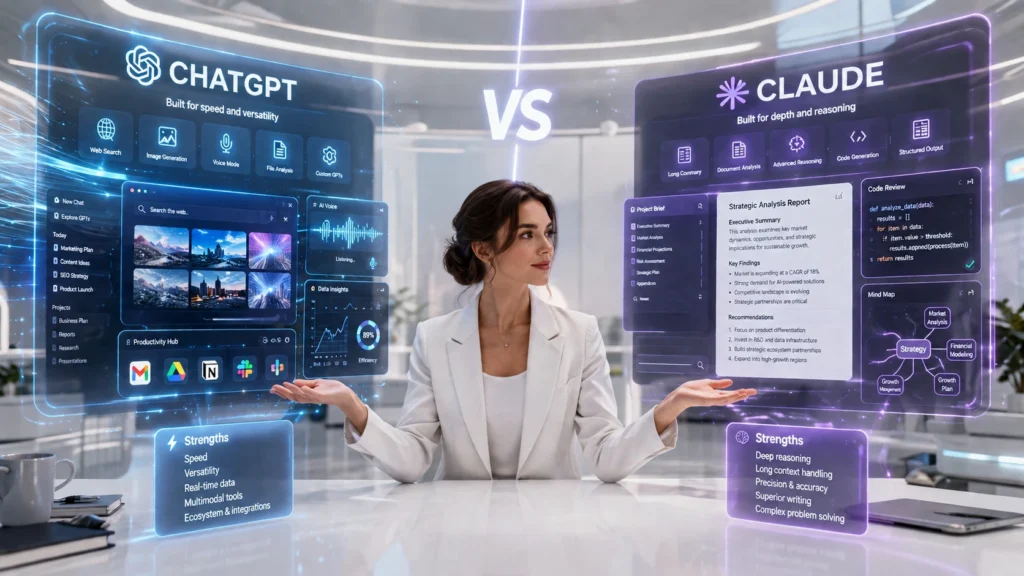
Anthropic has expanded Claude into a full document intelligence system. Users can now connect files, ask Claude to search through them, extract specific information, summarize content, and even generate presentations directly from uploaded documents.
Until recently, AI assistants were mostly limited to answering questions.
You uploaded a file.
The model gave you a summary.
Sometimes it missed context.
Sometimes it hallucinated details.
Most of the real work still stayed in human hands.
That boundary is now disappearing.
Anthropic has significantly expanded Claude’s document capabilities, turning it into something much closer to an intelligent file operator than a simple chatbot. Users can now connect Claude directly to document libraries, upload large files, search across content, ask for hidden details, request extracted information, and generate structured outputs such as reports, summaries, or slide presentations based entirely on the source material. (anthropic.com
)
This means Claude no longer treats a document as a passive attachment.
It treats the file as an active workspace.
A contract can be scanned for legal clauses.
A financial report can be searched for inconsistencies.
A 60-page PDF can be reduced into ten boardroom bullet points.
A technical manual can be converted into a presentation deck.
A policy document can be queried like a database.
And all of this happens inside a normal conversation.
Instead of manually opening folders, scrolling through pages, searching keywords, copying sections, or trying to understand where a certain detail was mentioned, users can now simply ask:
“Find the cancellation clause.”
“Show me every place where quarterly losses are mentioned.”
“Turn this into a six-slide investor presentation.”
“Summarize only the operational risks.”
“Extract all customer names and dates.”
Claude reads, searches, reasons, and returns the answer in context.
Anthropic’s new workspace connectors are designed specifically for business files, cloud documents, reports, PDFs, and collaborative office material, making Claude function more like an embedded research analyst sitting on top of your company knowledge base. (anthropic.com
)
This is a much bigger shift than it first appears.
Because searching for information has always been one problem.
Understanding which information matters has been the second.
Claude now starts doing both.
It can inspect documents at machine speed while preserving narrative context, relational meaning, and structural hierarchy between sections.
That sounds technical.
In business terms, it means less human reading.
Far less human searching.
Far less human formatting.
And dramatically less time wasted trying to locate something that probably exists somewhere in a forgotten folder.
The implications are obvious.
Internal reports.
Contracts.
Training manuals.
Research PDFs.
Meeting notes.
Presentations.
Knowledge archives.
Everything that used to sit as dead documentation is now becoming searchable operational intelligence.
This pushes AI one step further away from content generation and one step closer to practical office execution.
The browser chatbot era was useful.
The document operator era is considerably more dangerous.
Because once AI understands not just what you ask, but where your information lives, office productivity stops being about typing faster.
It becomes about who controls the best machine reader in the room.